Most new-homeowner households we ship to have the same story. The filter slot does not match a standard store size, so the previous owner jammed in something close and called it good. Custom air filters fix that in a week. This page walks you through how to tell if yours is one of the non-standard slots, how to measure without a second trip to the store, which MERV rating actually fits your summer, and the short list of first-month tasks that pay for themselves before the August utility bill lands.
TL;DR Quick Answers
Custom Air Filters
Custom air filters are HVAC filters built to the exact length, width, and depth your return grille or media cabinet actually measures, including the odd sizes that standard retail filters do not cover. They seal the slot, stop bypass air, and protect your equipment when your home's filter opening is not a stocked size.
Built to order in any length, width, and depth, usually to the nearest 1/8 inch.
The right fit when your return measures a non-standard size (common in older homes, additions, and high-end media cabinets).
Available in the same MERV ratings as standard filters: MERV 8 for basic dust and pollen, MERV 11 for pets and mild allergies, MERV 13 for fine particles and smoke.
Typically priced a few dollars above a comparable standard size, with standard ship times of a few business days at major U.S. manufacturers.
Measure the old filter's actual dimensions (not the nominal size on the label) or the slot opening itself before ordering.
Top Takeaways
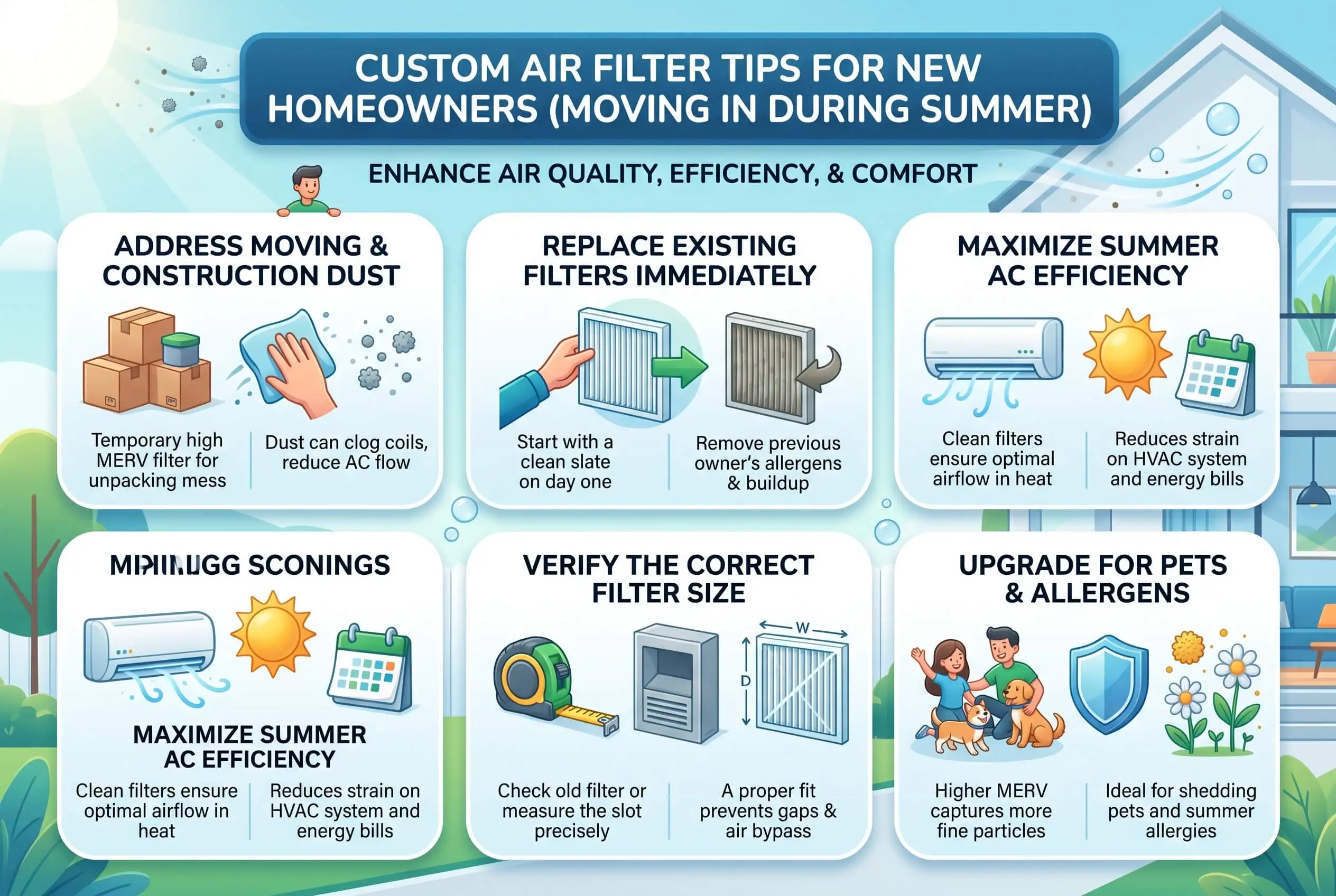
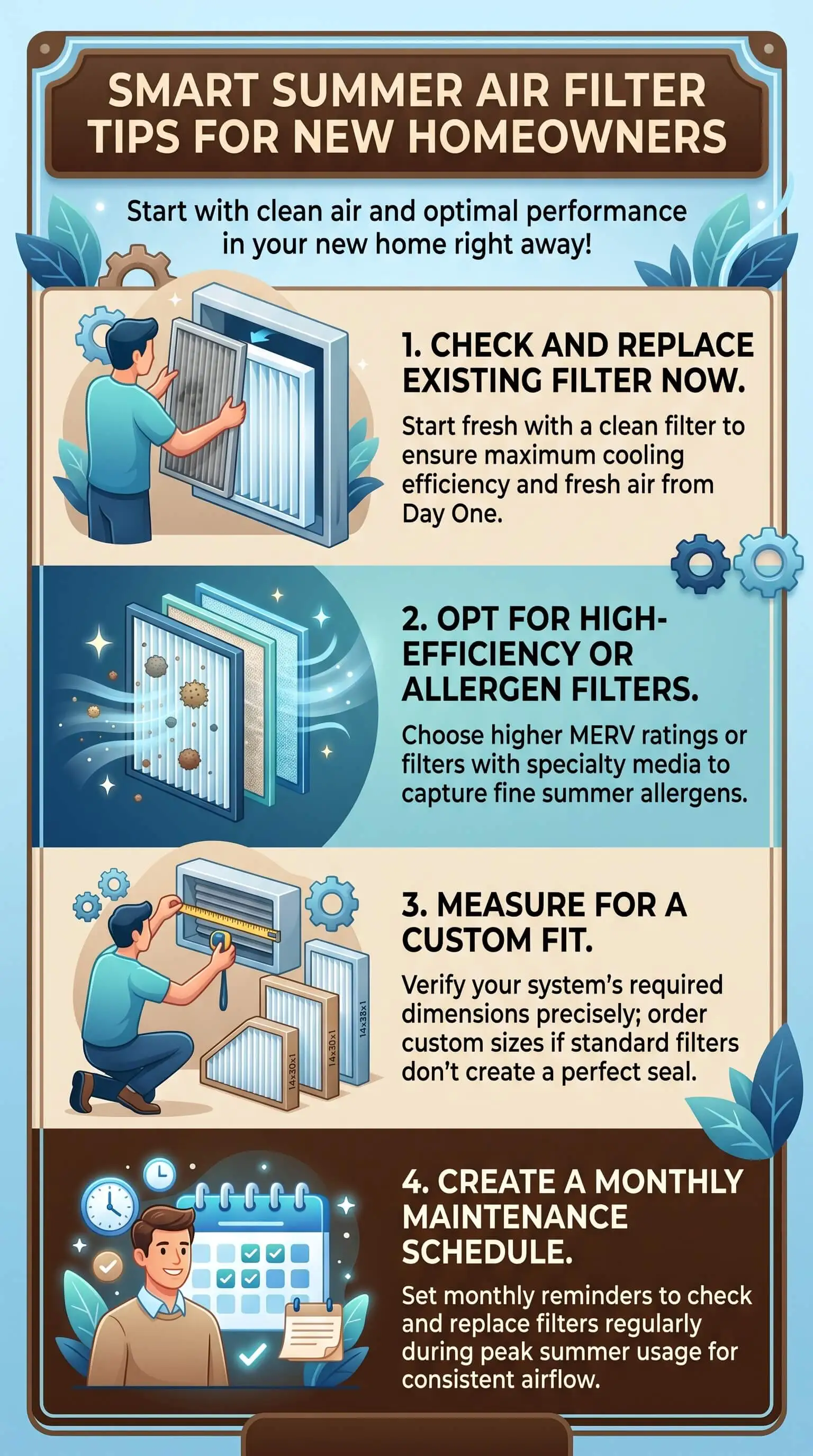
The filter that came with your new home has been running unattended for months and is almost always due for replacement on day one.
A meaningful share of U.S. homes have non-standard return sizes. Check the actual dimensions on the old filter before you shop.
Measure length, width, and depth to the nearest 1/8 inch. Do not round.
MERV 11 is the sensible default for most new-homeowner households. Step up to MERV 13 only if the equipment manual allows it.
Book a professional HVAC inspection inside your first 90 days. The system came with the house, and you do not yet know what it needs.
Why the First Filter in a New Home Matters More Than You Think
The filter in your return on closing day has been under load. Drywall dust from the inspection period, pet hair from whoever lived there before, and other factors that make pet shedding solutions so valuable, pollen from the open windows during the final walk-through, and whatever the previous owner kicked up moving their couch out the door all ended up in the same piece of pleated media.
An air filter only protects your home when clean media is doing the catching. Once the surface loads, airflow drops, the blower draws harder, and particles slip past the edges of the frame into the equipment you were trying to protect. Summer makes this worse because the system runs longer, and longer runtime on a dirty filter is the fastest way to shorten the life of a blower motor.
Swap it on day one. You will have a clean baseline to judge every system noise, every temperature swing, every airflow weakness in the house against. Do not inherit someone else's neglect.
How to Tell if Your New Home Needs a Custom Air Filter
Standard retail sizes cover most American homes. They do not cover all of them. Additions, older builds, high-end media cabinets, and anyone who modified the return over the years can leave you with a filter slot that wants something the big-box store will not carry.
The test is simple. Pull the filter. Look at the actual dimensions printed on the side of the frame, not the nominal size in big type. Write down what you see, to the nearest 1/8 inch. If that number does not turn up on a shelf or a standard product page, your home wants a custom filter.
Custom is not exotic. We build custom air filters to any dimension you send us, and the price gap between a custom and a standard size is smaller than most first-time homeowners expect. What you get back is a filter that actually seals the slot instead of leaving a half-inch of bypass gap on one side that lets unfiltered air run straight into the blower.
Slot empty when you moved in? Measure the opening itself. Length, width, depth. Do that before you drive anywhere.
Measuring Your Return Grille or Media Cabinet Correctly
Two minutes, a tape measure, a pencil. Here is the sequence our customer team walks people through every single day in July:
Turn the system off at the thermostat. A blower pulling air across an empty slot pulls debris deeper into the equipment.
Pull the existing filter or open the slot cover. Note the airflow direction arrow on the old frame before you toss it.
Measure length, width, and depth to the nearest 1/8 inch. A 19 3/4 inch slot takes a 19 3/4 inch filter. Not a 20. Rounding up is where most mistakes start.
Check depth twice on media cabinets. 4-inch and 5-inch filters look close at a glance, and swapping them is one of the top three ordering mistakes we see.
Stick a piece of tape with the actual dimensions inside the return cover. In six months, in the future you will be grateful.
Choosing the Right MERV Rating for a New Home in Summer
MERV is the scale that tells you what particles a filter catches. Higher numbers catch smaller stuff. Higher numbers also resist airflow more, which is why grabbing the highest available rating is not always the right call for a blower you have not tested yet.
For a household that has not had an HVAC tech out to read static pressure, these are the ranges that actually work in real homes:
MERV 8 is a safe starting point if you know nothing about the system. It handles everyday dust and pollen without stressing the blower.
MERV 11 is the step up most households want. Pet owners, mild allergy sufferers, and anyone moving into a home with unfamiliar construction dust all land here. The airflow penalty is small on equipment built in the last 15 years.
MERV 13 catches fine particles and smoke. We point summer movers toward this rating when wildfire smoke is a regional concern or when anyone in the household has asthma.
One catch. A filter with a high MERV rating only works if the system can pull air through it. Check the equipment manual, or the sticker inside the air handler, for the highest rating the manufacturer actually lists. If the manual caps you at MERV 11, do not buy 13. You will choke the blower and lose the airflow benefit you were paying for.
Other HVAC Tasks Worth Doing During the First Month
The filter is the fast win. These are the follow-ups our field team recommends knocking out before the first full utility bill lands:
Walk the outside and clear a two-foot zone around the outdoor condenser. Mulch, leaves, tall grass, and that shrub the previous owner let run wild all starve the coil of airflow and make the system work harder in July heat.
Check every bedroom and hallway return for a secondary filter. Older homes often have filters at multiple returns, and one or two almost always got forgotten by the last owner.
Reprogram the thermostat. Factory defaults assume a 9-to-5 schedule no real family keeps. Set it to match how your household actually lives.
Book a professional HVAC inspection in your first 90 days. A tech catches the expensive stuff early: bad capacitors, low refrigerant charge, dirty evaporator coils. You also get a real read on the highest MERV rating your blower can actually handle, which helps with properly sizing your air conditioning unit.
"About one in five of the custom orders we ship goes to a homeowner who just moved in. The story is almost always identical. The previous owner was buying the closest standard size and stuffing foam around the edges to make it fit. We get the actual measurement from the customer, build the filter to that dimension, and within a week they tell us the bedroom that used to feel stuffy suddenly breathes like the rest of the house. After manufacturing filters for over a decade, we can say the fix is almost always measurement, not money."
7 Essential Resources
Seven sources worth bookmarking for your first summer in a new home. Each one is maintained by a U.S. government agency or a public-research authority, and each link goes to the exact page where the guidance lives.
1. The EPA's Plain-English Guide to MERV Ratings
The EPA page on MERV is the best starting point if you have never shopped for filters by rating before. It explains what each number means, why higher is not automatically better, and where MERV 13 actually earns its place in a residential system.
Source: EPA, What is a MERV rating?
2. The ENERGY STAR HVAC Efficiency Checklist
ENERGY STAR's heating and cooling page is a short, no-nonsense walkthrough of the highest-return efficiency moves a homeowner can make. It covers filter changes, duct sealing, thermostat setup, and when to consider replacement equipment. No product pitch, no upsell.
Source: ENERGY STAR, Heat and Cool Efficiently
3. The EPA's Introduction to Indoor Air Quality
A plain-language primer on what actually floats through a typical home's air, where it comes from, and what ventilation and filtration do about it. Read it once and the language on product pages and technician invoices stops feeling like jargon.
Source: EPA, Introduction to Indoor Air Quality
4. The EPA's Wildfire Smoke Preparedness Guide
Summer and wildfire smoke are now linked across most of the western U.S. and parts of the Southeast. The EPA page covers filter selection during smoke events, when to run recirculate mode, and the do-it-yourself box-fan cleaner that can hold you over on the worst days.
Source: EPA, Wildfires and Indoor Air Quality
5. The Department of Energy's HVAC Overview
The DOE page explains how heating, cooling, and ventilation fit together in a home, and why small efficiency changes compound across a full year of runtime. Useful context if you are weighing whether to upgrade equipment that came with the house.
Source: DOE, Heating, Ventilation, Air Conditioning, Refrigeration, and Water Heating
6. The EPA's Full Homeowner Guide to Indoor Air Quality
The long-form companion to Resource #3. This one goes deeper on source control, ventilation, and what to do when you suspect a specific pollutant in your home. The chapter on combustion sources is useful if your new house came with a gas range or a wood-burning fireplace.
Source: EPA, The Inside Story: A Guide to Indoor Air Quality
7. The Building America Solution Center's High-MERV Filter Guide
A DOE-affiliated technical guide maintained by Pacific Northwest National Laboratory. It explains how high-MERV filters affect static pressure, what a system has to be spec'd for to handle MERV 13, and what a home energy rater looks for during inspection. Dense, but authoritative.
Source: Building America Solution Center, High-MERV Filters
3 Statistics
Three verified numbers worth knowing when you are setting up an HVAC system for the first summer in a new home. Each one comes from a primary U.S. government source and gets reframed around what it actually means for your filter decisions.
1. Indoor Air Can Be 2 to 5 Times More Polluted Than Outdoor Air
The EPA's Report on the Environment finds that concentrations of some common pollutants inside U.S. homes run 2 to 5 times higher than typical outdoor levels, and can run more than 100 times higher in short-term spikes. That number climbs during a move. Fresh paint off-gases, new carpet off-gases, and the dust that lives in every settled home gets stirred up by people walking unfamiliar routes through unfamiliar rooms. The filter in your return is the main thing standing between that loaded indoor air and the lungs of the people you moved in with.
Source: EPA, Report on the Environment: Indoor Air Quality
2. Roughly 11.8% of Americans Moved in the Past Year
The U.S. Census Bureau's American Community Survey puts the 2024 mover rate at 11.8% of the population. One in roughly eight people changed homes in a single year. The moving industry consistently reports that more than half of those moves land between May and September, which means if you are reading this in July, you are in a crowd. You are also competing with that same crowd for HVAC tech appointments, which is the single best reason to book your inspection now instead of in August.
Source: U.S. Census Bureau, ACS 1-Year Migration Estimates
3. Over Half of a Typical Home's Energy Goes to Heating and Cooling
The U.S. Energy Information Administration reports that space heating and air conditioning together accounted for about 52% of the average U.S. household's annual energy consumption in 2020. They were the two largest end uses in the home. A clogged or wrong-size filter forces the blower to work harder, which pushes that share higher. Getting the filter right in your first month of ownership is one of the cheapest levers you have on your summer utility bills.
Source: U.S. Energy Information Administration, Use of Energy in Homes
Final Thoughts and Opinion
We have shipped filters to a lot of new-homeowner households over the years. The pattern is consistent enough to state plainly. The people who handle the filter situation in their first week settle into summer faster, run a cooler house, and pay less to do it. The people who wait spend August troubleshooting airflow problems that started as a dirty filter in June.
Custom filters are not a luxury upgrade. They are the correct product for a return that happens to measure 19 3/4 by 21 1/2 instead of 20 by 22. If your home wants one, order it, install it, set a recurring reminder on your phone for the next change, and get on with your summer. That is the whole job. You are the one protecting your family's air. We are here to make sure the best air filters actually fit the slot you are putting them in.
Frequently Asked Questions
Q: How do I know if my new home needs a custom air filter?
A: Pull the existing filter and check the actual dimensions on the side of the frame. If the actual size is not a standard retail size (for example, 19 3/4 x 21 1/2 x 1 instead of 20 x 22 x 1), you want a custom filter.
Older homes and homes with additions are the most common custom-size cases.
If the old filter sat loose in the slot or had foam stuffed around the edges, the previous owner was using the wrong size.
If no filter was in the return when you arrived, measure the slot opening itself before you buy anything.
Q: What size filter should I buy before I move in?
A: Ask the seller or the previous owner what size they used, and ask to keep one of their old filters as a reference. If you cannot get that information, wait until you are on-site and can pull the filter yourself. Buying blind almost always costs you a return trip.
Q: How often should I change the filter in my first summer in a new home?
A: Check it at 30 days and plan to change it between 30 and 60 days for the first cycle. New-home dust load runs higher than a settled household, so the first filter loads faster than the ones that follow. After the first two changes, most households settle into a 60-to-90-day rhythm.
Q: What MERV rating is safe for most new homes?
A: MERV 11 is the safe default for HVAC equipment built in the last 15 years. MERV 13 is the right call for wildfire-smoke regions, households with asthma, or significant allergies, as long as the equipment manual lists that rating as supported.
Check the sticker inside the air handler for a maximum MERV rating.
If the manual caps you at MERV 8, do not install MERV 13. You will choke the blower.
Q: Is a custom air filter more expensive than a standard one?
A: The price difference is smaller than most new homeowners expect, typically a few dollars per filter. What you save is the foam stuffing, the bypass air around a misfit filter, and the airflow problems that stuffing-and-hoping eventually creates.
Q: How long does it take to get a custom air filter delivered?
A: Custom orders at a major U.S. manufacturer typically ship within a few business days. Plan on a week from order to install if you are on a standard delivery window.
Q: Can a wrong-size filter damage my new HVAC system?
A: Over time, yes. A filter that does not seal against the slot lets unfiltered air bypass straight into the blower and coils, where dust and debris build up on components that are not designed to be cleaned by the homeowner. A properly sized filter, whether standard or custom, is the cheapest form of preventive maintenance you can do.
Next Step
Measure your return once, write the actual dimensions on a piece of tape inside the cover, and order the exact size. See the full range of sizes, MERV ratings, and delivery options at custom air filters.
Better Air For All.